


AI FOR KIDS ZENVY AI PROGRAM
### AI for Kids Introduce your child to the exciting world of **Artificial Intelligence** through fun, creative, and hands-on learning. Our AI for Kids program helps children understand AI concepts, explore AI tools, create projects, and develop **creativity, problem-solving, digital skills, and future-ready thinking** in an engaging and age-appropriate way.
Start Know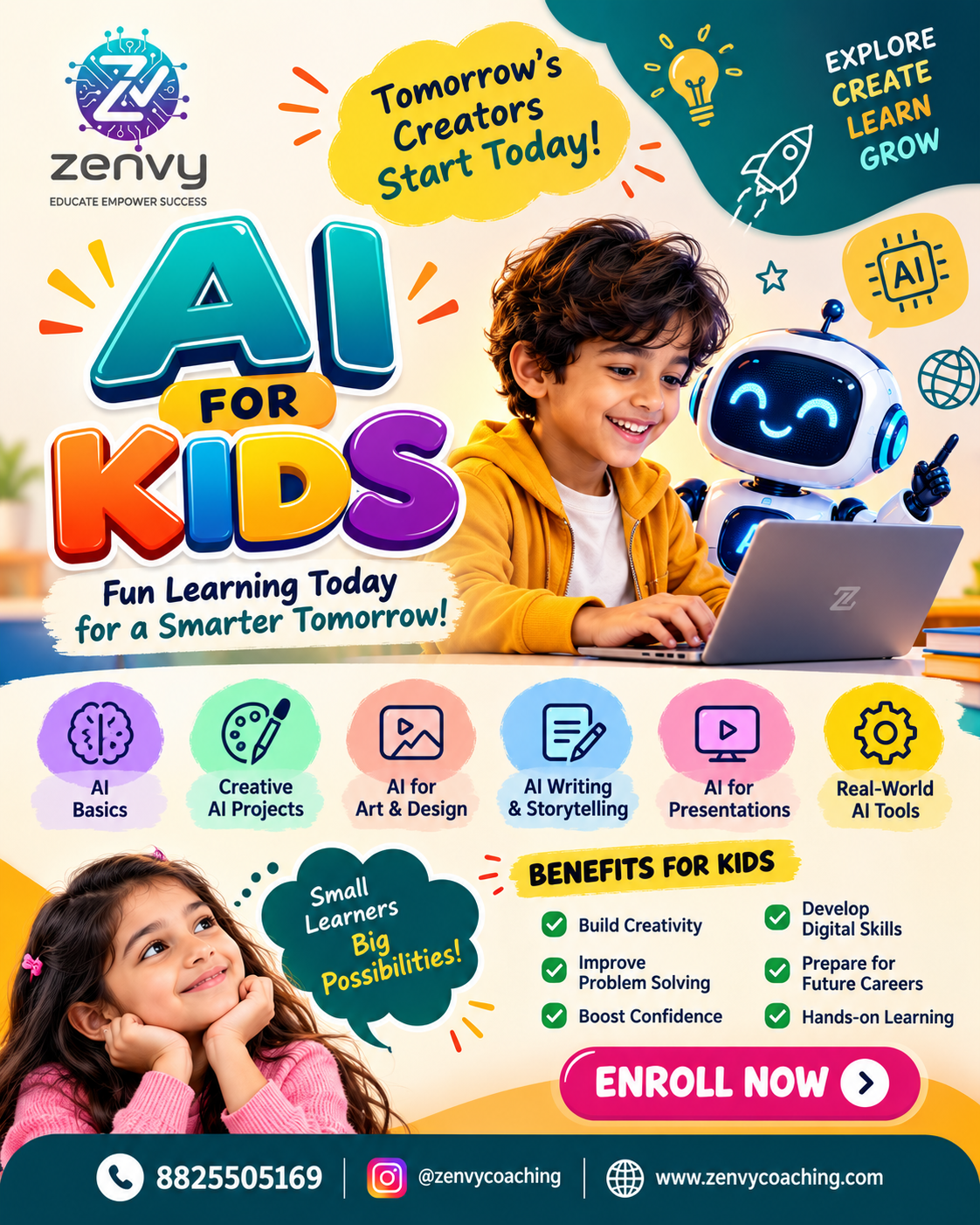


Learn from Experts, Grow with Confidence Why Choose Zenvy Learning
Expert-Led Training
Structured Learning Levels
Proven Skill Development


See Our Popular Courses
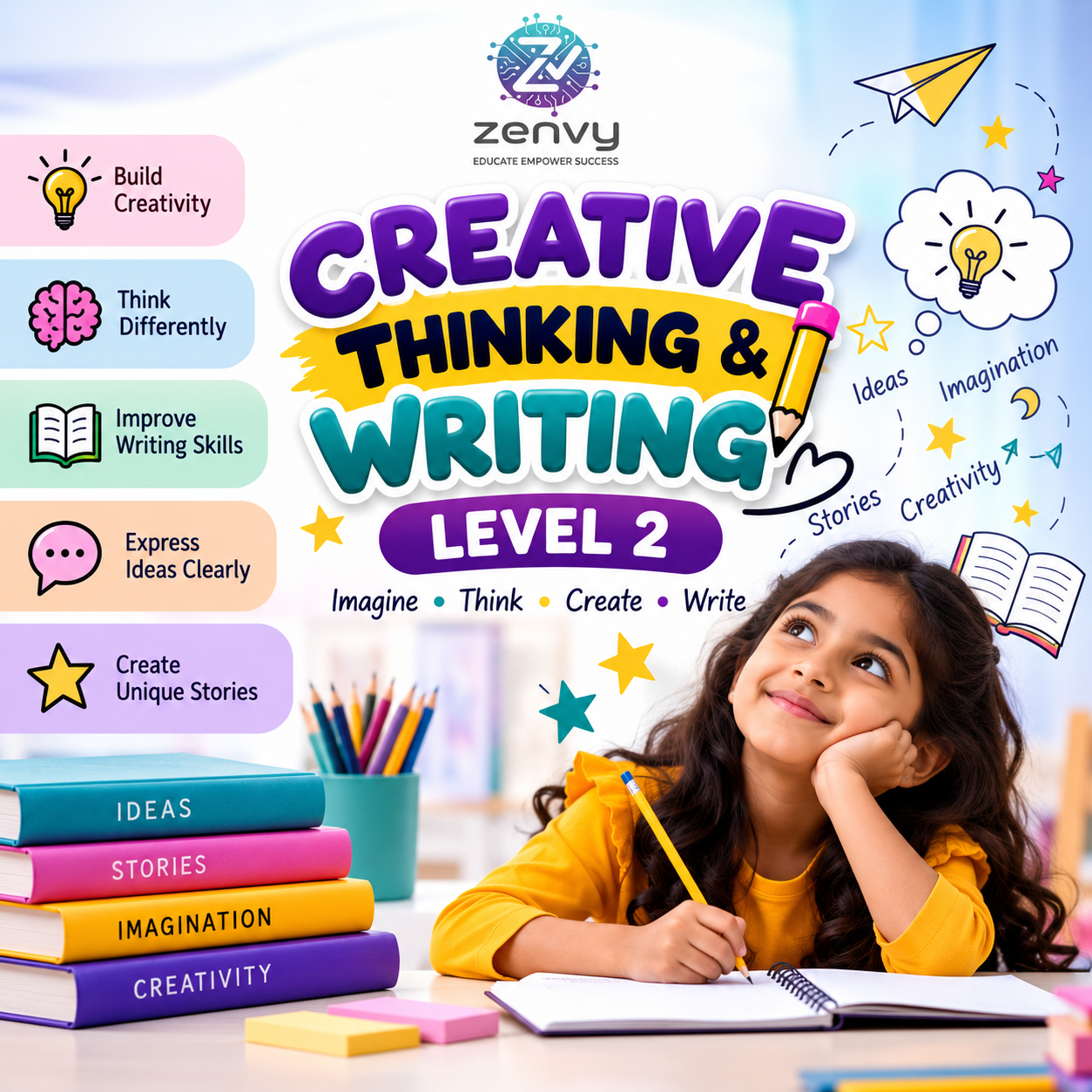
CREATIVE THINKING ADVANCED

Vedic maths for competitive exams


Curriculum Maths Grade 2

Curriculum Maths Grade 6

Phonics Level 2

How Our Learning Program From Basics to Mastery
By the Numbers of Our Impact
10K
100+
50+
Enquire Us

Learn from Our Expert Instructors

CHARU Zenvy

GURU Zenvy

JENIFER Zenvy

Reshma Zenvy
Explore Our Latest Blogs
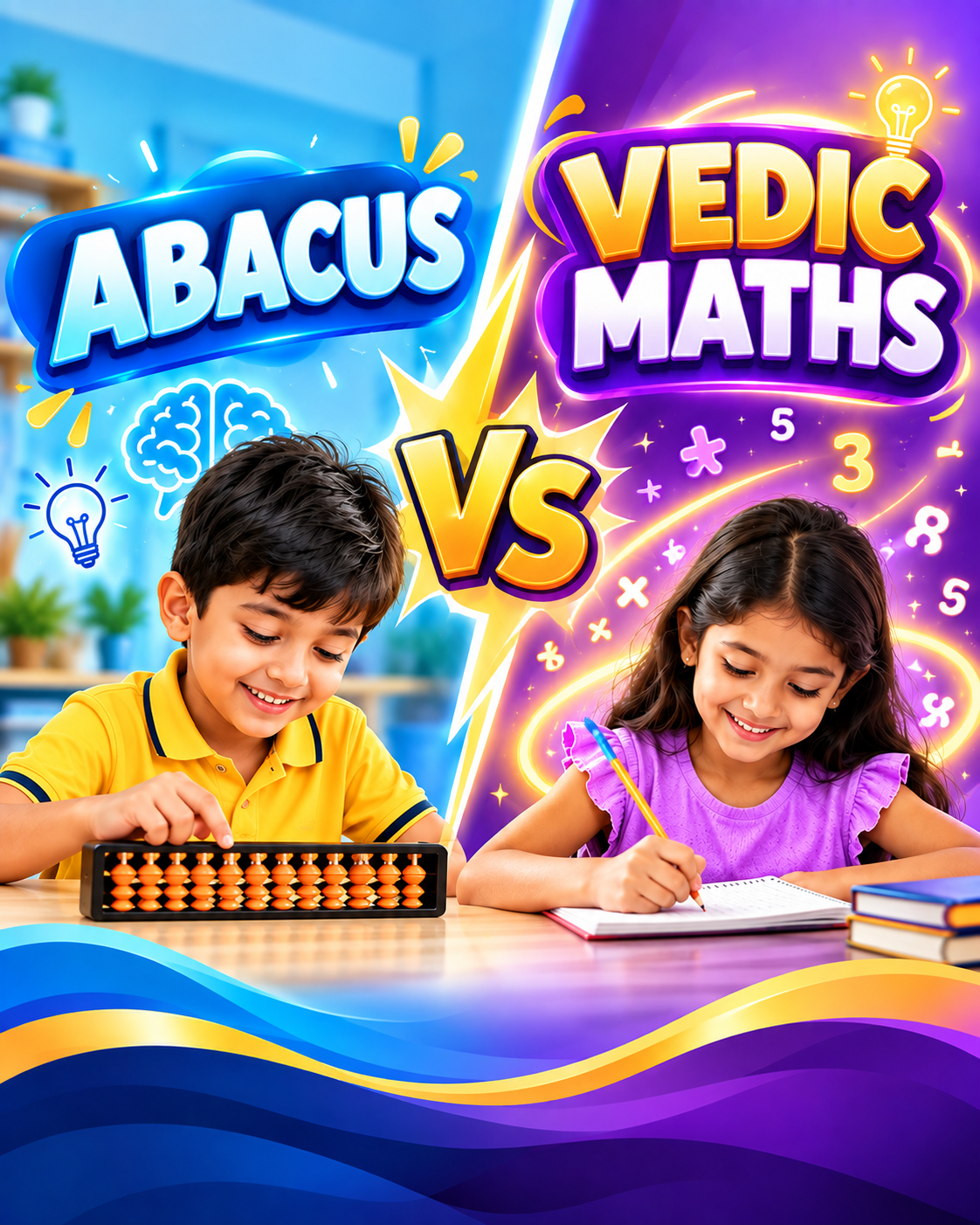
Abacus vs Vedic Maths: Which One Should Your Child Learn First?
Many parents in Coimbatore ask the same question when enrolling their child in a math enrichment program: should I choose Abacus or Vedic Maths? At Zenvy Coaching, we teach both, and the honest answer is that they serve different purposes and work best at different ages.
Abacus training uses a physical or mental bead frame to build visualization skills. Children as young as 5 or 6 can start, and the core benefit is improved concentration, memory, and mental calculation speed. Because abacus relies on picturing the bead frame in the mind, it is especially powerful for young learners still developing focus and number sense.
Vedic Maths, on the other hand, is a collection of ancient calculation sutras (formulas) that simplify multiplication, division, squares, and other operations. It works best once a child already has a grip on basic arithmetic, usually from age 8 or 9 onward, and it directly supports school-level and competitive exam math by making calculations faster and reducing silly mistakes.
So which should come first? If your child is in LKG to Grade 2, start with Abacus to build the mental calculation foundation. If your child is in Grade 3 and above and already comfortable with basic arithmetic, Vedic Maths will give faster, more visible results, especially before competitive exams like NTSE or Olympiads.
Many of our students at Zenvy Coaching actually do both in sequence: Abacus first for the mental math foundation, then Vedic Maths to apply that speed to school-level problems. This combination consistently produces the strongest results we see in Grade 4–8 students.
If you are unsure which path fits your child's age and current level, our team at Zenvy Coaching in Coimbatore can assess them and recommend the right starting point. Reach out to book a free demo class today.
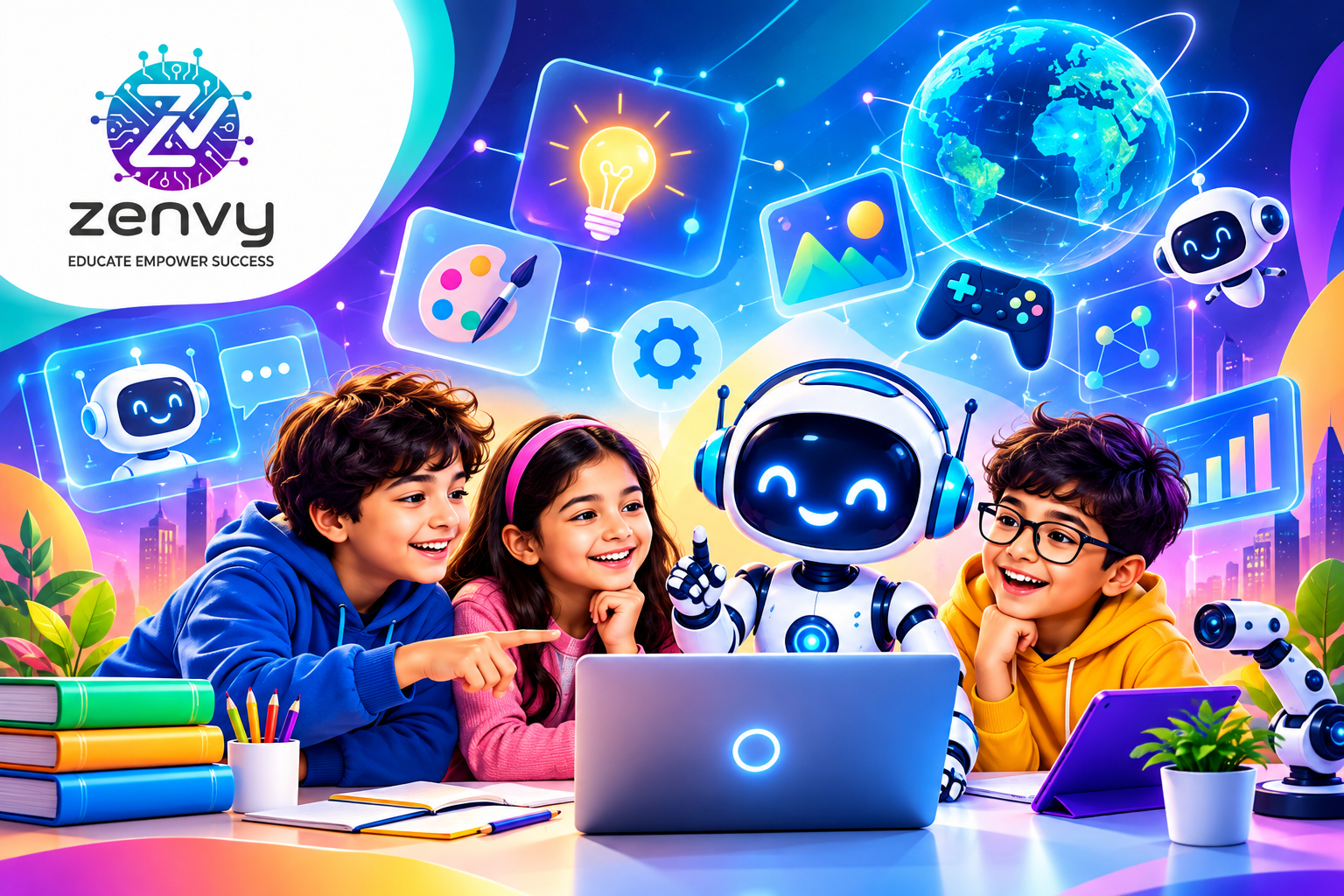
AI for Kids: Why Zenvy Coaching is Bringing AI Education to the Next Generation
Zenvy Coaching's new AI for Kids program introduces children to artificial intelligence through hands-on, age-appropriate learning.
Artificial intelligence is no longer just a buzzword for adults in tech — it's fast becoming a core skill for the next generation, and that's exactly why Zenvy Coaching is introducing AI for kids as part of our growing range of programs.
Just like Vedic Maths trains the brain for speed and Phonics builds strong readers, AI for kids is designed to build the thinking skills children will need for tomorrow: problem-solving, computational thinking, creativity, and an early, confident understanding of how AI actually works. Instead of passively using apps and chatbots, children learn to think alongside AI — spotting patterns, asking better questions, and understanding the ideas behind tools like image generators, voice assistants, and chatbots in simple, age-appropriate language.
More and more parents are searching for "AI classes for kids near me" and "AI education for children," and for good reason — early, guided exposure to AI concepts gives children a real head start, the same way early phonics or early Vedic Maths training does. Zenvy Coaching's upcoming AI program for kids is being built with that same philosophy: structured, hands-on, and taught by trainers who already run AI workshops for business and startup audiences, now adapting that expertise for young minds.
This new AI for kids course will sit alongside Zenvy's existing Vedic Speed Maths, Abacus, Phonics, and communication skills programs, giving children a genuinely future-ready foundation — critical thinking, curiosity, and comfort with AI, built early and taught right.
AI for kids isn't about turning children into programmers overnight — it's about raising confident, curious thinkers who won't be left behind in an AI-driven world. Interested in being among the first to enroll your child in Zenvy Coaching's AI for kids program? Reach out today to register your interest and get updates as we launch.
📞 +91 88255 05169

How Abacus Training Improves Concentration and Memory in Children
Abacus training improves concentration and memory by teaching children to picture numbers instead of just counting them. Once a child moves from the physical bead frame to solving sums mentally — "mental abacus" — the brain shifts from verbal memory to visual-spatial memory to hold numbers. That shift drives most of the benefit.
Concentration builds because abacus calculation punishes distraction. A child has to track several bead positions in sequence, and losing focus for even a second breaks the sum. Repeated weekly practice trains sustained attention as a side effect. A 2024 study of 441 elementary schoolchildren (Zhejiang University and UT Austin) found abacus-trained students showed clear gains in attention and short-term memory over non-trained peers, with the effect strongest by grades 4 and 5.
Memory improves specifically in visuospatial working memory — the mental "sketchpad" used to hold and manipulate images. A 2025 University of Ghana study comparing 90 trained children to 100 untrained peers found a statistically significant improvement after training. Brain-imaging research backs this up: abacus experts recall digits using visuo-spatial brain regions rather than the verbal-memory regions non-experts rely on.
Parents typically notice progress in this order: faster mental calculation, longer focused homework stretches, better recall of multi-digit numbers, and more confidence with word problems. Most studies measured results over roughly a school term of consistent practice — around 2 hours a week — with consistency mattering more than intensity.
Why Communication Skills Matter More Than Ever (And How to Build Them Early)
Talk to any employer, teacher, or parent today, and you'll hear the same complaint: knowledge isn't the bottleneck anymore — the ability to express it is. A child can solve a math problem perfectly and still freeze when asked to explain the answer aloud. An adult can have brilliant ideas and still get passed over because they can't pitch them clearly. Communication has quietly become the skill that decides who gets heard.
It's Not Just About Talking
Most people equate communication with speaking well. In reality, it's a bundle of skills working together:
- Verbal clarity — saying what you mean without rambling
- Listening — actually absorbing what the other person says, not just waiting for your turn
- Body language — posture, eye contact, and tone that back up your words instead of contradicting them
- Written expression — emails, messages, and reports that get read, not skimmed and ignored
Weakness in any one of these undercuts the rest. A confident speaker who never listens comes across as arrogant. A great writer who can't hold eye contact loses the room in interviews.
Why Starting Early Changes Everything
Communication is a habit before it's a skill. Children who get comfortable articulating their thoughts early — asking questions, describing their day, disagreeing respectfully — carry that ease into classrooms, interviews, and boardrooms years later. Waiting until adulthood to "fix" communication means unlearning years of hesitation first, which is always harder than building confidence from scratch.
This is why communication training works best as a habit-building exercise, not a one-time workshop. Small, consistent practice — a two-minute daily share, a weekly discussion round, structured storytelling exercises — does more than a single intensive session ever will.
Three Practical Ways to Build the Skill
- The daily recap habit. Ask for a 60-second summary of the day — not a list of events, but what mattered and why. This forces structured thinking before speaking.
- The disagree-politely drill. Practice stating an opposing opinion using "I see it differently because…" instead of "You're wrong." It's a small phrase shift that changes how conversations land.
- The listen-then-repeat exercise. Before responding in a discussion, restate what the other person said in your own words. It's uncomfortable at first and builds real listening fast.
The Bigger Picture
Strong communicators aren't necessarily the loudest people in the room — they're the clearest. They ask better questions, explain complex ideas simply, and build trust faster because people feel understood around them. That's not a personality trait; it's a trained skill, and like any skill, it responds to deliberate, structured practice.
Whether you're raising a child, training a team, or working on your own presence, the investment is the same: consistent, small reps over time — not a single crash course. The results, though, compound for a lifetime.
What Our Parents Are Saying
Real experiences from families who have joined our Zenvy learning community.

Staff Feedback
I recently completed my Teacher Training
and Communication Course at Zenvy Institute, Coimbatore and it was truly a
wonderful experience. The trainers were highly supportive, knowledgeable, and
always encourag to improve our skills with confidence.
I highly recommend Zenvy Institute - Coimbatore to anyone looking to build
strong communication skills and become a confident teacher.
Arokia Jenifer

Abroad Reviews - From Texas - Abacus
Awesome my child enjoys learning Abacus from Zenvy
Smriti Sharma

Spoken English
Very happy to choose Meena mam for our daughter's vocabulary training... She is doing good now in a short period of 2months... Her English learning skills has been improved. Meena mam is taking every student individual attention and improving them, so thankful to her
Kirubha Purushothaman

Grade Subjects (Physics & Maths)
With personalised tutor, my son (Grade9) showed better results in his academics (physics & chemistry - IGCSE). I appreciate their care and efforts in teaching the students
Awesome group work. Parents can definitely go for it for the better learning experience. They are so kind,comfortable and encouraging to work with. Happy being part of this
Mythily Santhalingam

Staff Feedback
Zenvy offers great teaching opportunity for me with advanced teaching technologies and methodology. They extremely focus on the outcome from the children.
Reshma Lathif

Abacus and Phonics
Excellent classes. And teachers are friendly so children enjoy classes. My son sai shrimath is studying in online he enjoys both abacus and phonics.
Karthikeyan S

Handwriting
Handwriting improvement classes are fantastic! My child's handwriting has become neat and legible
NANDAKUMAR S

Spell Bee
“Best Spell Bee coaching in Coimbatore. The training is systematic and helps children build strong vocabulary.”
Gangadharan Natarajan

Vedic Maths
“Best Vedic Maths classes in Coimbatore. My child’s calculation speed has improved drastically. The teaching method at Zenvy is very structured and easy to understand.”
Sarva's Adventures

Public Speaking
Best places for kids to improve communication skills. My child has improved a lot in public speaking. Thanks to meena ma’am.